
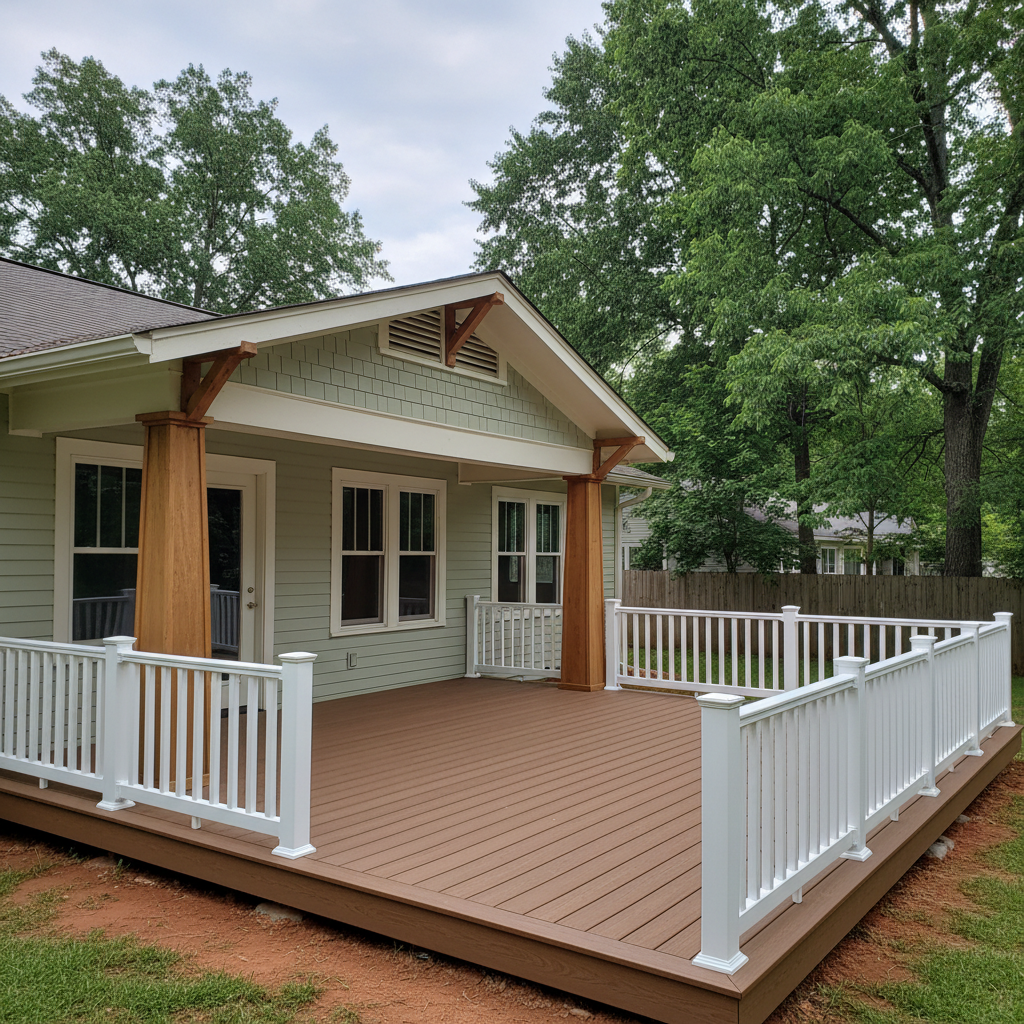
Smyrna has a lot of deck builders right now. Some of them are framing crews with a truck and a stack of business cards who learned decks on the job last summer. A deck holds people up off the ground, sometimes twelve or fourteen feet up if your lot slopes toward Rottenwood Creek. It's worth knowing what separates a builder who understands that from one who's just good with a nail gun.
Start with the ground, because Smyrna's clay doesn't forgive bad footings
Most of this area sits on Georgia red clay, which swells when it's wet and shrinks hard when it dries out in July and August. A footing poured too shallow, or poured without enough concrete around it, can shift a few inches over a couple of seasons as that clay moves. Georgia's frost line is shallow compared to the north, usually around 12 inches, so you're not fighting frost heave the way they do in Ohio. You're fighting expansive clay instead. A builder who knows the soil here digs footings 24 to 36 inches deep depending on the post load and the span, and sets posts on poured concrete or helical piers rather than just dropping a precast block on dirt and calling it done. If a builder tells you footings don't matter much, that's your sign to keep looking.
Permits aren't optional, and skipping them costs you later
Cobb County issues the permit for most deck work in and around Smyrna, and it typically involves at least two inspections: one after the footing holes are dug (sometimes before the concrete goes in), and one at framing, before the decking boards go down. A final inspection usually covers railings and stair geometry. A builder who says they'll "just build it quiet" to save you the fee is setting you up to deal with it when you sell the house and the buyer's inspector flags an unpermitted structure. Older neighborhoods closer to downtown Smyrna, like Belmont Hills or the streets off Concord Road, often have decks from the 60s and 70s already attached to the house with no flashing and footings that were never inspected. If you're replacing one of those, expect the inspector to look harder, not easier.
If your lot is in a subdivision built in the last 15 to 20 years, say off the Silver Comet corridor or in Vinings Estates, there's a decent chance you've also got an HOA with an architectural review process. That can mean submitting a material sample or paint color before you ever call the county. A builder who's worked in your subdivision before will already know what the HOA wants to see on paper.
The ledger board is where most failures start
If the deck attaches to your house, the ledger board is the single most important connection on the whole structure, and it's the one most often done wrong. It needs to be lag-bolted or through-bolted into the house framing, not screwed. It needs flashing that tucks up under your house wrap or siding, with a kick-out at the bottom so water runs away from the house instead of behind the board. Atlanta gets heavy, fast thunderstorms most of the summer and the remains of a few tropical systems most falls, and water that gets trapped behind a ledger board without flashing will rot the rim joist before you ever notice a problem on the surface. Ask anyone bidding your deck how they're flashing the ledger. If they don't have a specific answer, that's a real problem, not a small one.
Material choice matters less than fastener choice
Pressure-treated pine is still the most common frame material here, and it's fine for the structure, but almost all of it today is treated with ACQ, which corrodes plain galvanized fasteners over a few years. Joist hangers and screws need to be rated for ACQ contact, usually labeled G185 or stainless. A builder using the wrong hardware won't cause a failure next year. It'll show up in 6 or 8 years as rust streaks and loosening connections, right when you've forgotten who built it.
For the decking surface itself, you're choosing between pressure-treated pine, which needs restaining every 2 to 3 years in this humidity or it grays and checks, and composite, which costs more up front but doesn't need that cycle and usually carries a 25-year warranty against rot and insect damage. Composite boards also need a 1/8-inch gap between them for expansion in Georgia's summer heat, tighter than that and boards can buckle. None of this is complicated, but it's the kind of detail that tells you whether someone's done this a hundred times or just started.
What to ask, and what should make you walk
- Ask for proof of license and liability insurance, and call to verify it rather than taking a card at face value.
- Ask how deep the footings will go and why, based on your specific span and post spacing, not a one-size answer.
- Ask who pulls the permit. If it's not them, that's a cost and a delay you need to know about now.
- Walk away from anyone asking for more than a third down before work starts. Walk away from anyone who won't put the footing depth, fastener type, and board spacing in writing on the estimate. A builder who's proud of the work will put it on paper without being asked twice.
A deck in Smyrna has to deal with clay that moves, summers that cook a finish, and storms that find every gap in flashing you didn't seal. Get a few bids, ask the same five questions of each one, and the gaps between contractors usually show up fast. We cover inspections and repair estimates as well as new builds, if you want a second opinion on a bid you already have. More on how we approach it is on our deck builder page.